Are Catamarans Good Boats For The Chesapeake Bay?
Yes, catamarans are most definitely great boats for the Chesapeake Bay! When considering pleasure boats suited for the Chesapeake area, and the relaxed boating/cruising lifestyle we aspire to, catamarans absolutely fit the bill. From small two-person daysailers to palatial cruising platforms that offer unprecedented luxury and comfort afloat, many catamarans have it all. Depending on one’s budget and cruising plans, a cat is worth a look.
A marvelous evolution has taken place in the recreational boating industry over the last number of years, and today’s multihull choices offer outstanding platforms for enjoying all the Bay has to offer, in both power and sail cats.
Let us look at some of the reasons to consider a catamaran as your next cruising boat. Crusader Yachts also happens to be your Excess Yachts catamaran dealer in Annapolis!

(Above image: The spacious interiors on catamarans, like this Excess 14, make staying on board much more comfortable.)
EASY BOATING
Chesapeake Bay is the largest inland tidal body of water in North America. With an expanse of 4,500 square miles (about the area of Connecticut), the Bay has much to offer anyone interested in exploring thousands of miles of its coastline.
The Bay is protected, with tidal ranges of less than two feet, and the two-knot current is negligible in most cruising areas. It is a less challenging environment for boaters at all skill levels, while full of natural beauty and destination diversity. Of particular interest to cruisers, the bottom is a friendly mix of mud and sand. Chesapeake Bay is all about easy boating.
However, the Bay is surprisingly shallow in many areas, which is why we suggest choosing a cruising boat with reduced draft. It is rare to find large bluewater sailboats with a deep draft of seven feet or more, tucked up in quiet and shallow creeks. To really enjoy the Bay, it is best to cruise on boats that draw less than six feet, five is better. While many anchorages may show more water on the charts, the real attraction is often the surrounding areas that beckon those on boats that will not run aground around every bend.
Catamarans typically have shallow keels, or centerboards that keep draft to a minimum. Even large boats, such as those from Lagoon, Leopard, Excess, Fountaine Pajot, Nautitech, and Seawind, draw less than five feet. (French cats were often marketed as beachable, as this capability is appealing to boat owners in Mediterranean waters.)
Another factor that contributes to easy boating is the outstanding utility of a cat’s swim platforms and dinghy davits. It is a simple matter to launch and retrieve the boat’s tender. Getting in and out of the dinghy to head for shore does not require gymnastics of any kind, which becomes an issue with age, kids, and dogs. And access from the water could not be easier. When alongside a floating dock, getting on and off a catamaran is child’s play, even for a dog.
In addition to a cat’s ability to get close to shore, anchoring a catamaran is simplified because of the wide foredeck area. Proper anchor technique does require use of a bridle to share the pull of the anchor rode between the two bows. This keeps the boat from swinging in the breeze. With a little practice this becomes a normal procedure of cruising on a catamaran.
Sailing a cat is not more difficult than sailing a monohull, although purists may find it less exciting. Sails are on roller furling gear these days and most sail plans and rigging layouts emphasize ease of use rather than maximum performance. Some builders, such as Excess catamarans, make performance a priority to keep the thrill in sailing, and sail management and helm positions are situated so the crew can focus on sailing the boat rather than adjusting the autopilot.
Honestly, most cruising catamaran sailors do not embrace the elegant dance with wind and waves that performance monohull sailors find most satisfying, when they are in the groove, heeled over with the bit in their teeth.
The visibility from a cat offers an unobstructed view of the world around the boat, whether under way or sitting peacefully at anchor.
And, of course, the outstanding maneuverability of a catamaran, with engines spaced far apart in each hull, provides superior handling without the need for thrusters on all but the largest catamarans. I can show most anyone how to walk a cat sideways using just the engines. It is so simple it soon becomes second nature and adds to the “easy boating” factor.
Finding a slip for a beamy, sailing catamaran can be a challenge if one’s expectations are not realistic. This genre of recreational boat has only evolved in recent years into the popular choice of today. So, finding a well-protected slip for such a modern boat can be more difficult in older marinas. (Power cats do not have the same issue, in my experience, as they are no wider than a motoryacht so will fit into a slip normally reserved for them.)
For a permanent home in a marina that checks all the boxes, it may take a bit of shopping around to find the right situation that will work long term. But that is true for any new boat.
While cruising, of course, slips are often kept available at the end of a dock, which is fine if one doesn’t mind a longer walk when taking the dog ashore. (It is good to stretch one’s legs after a day on the water anyway.) Against a bulkhead can be a better choice if protection from boat traffic or weather is debatable.
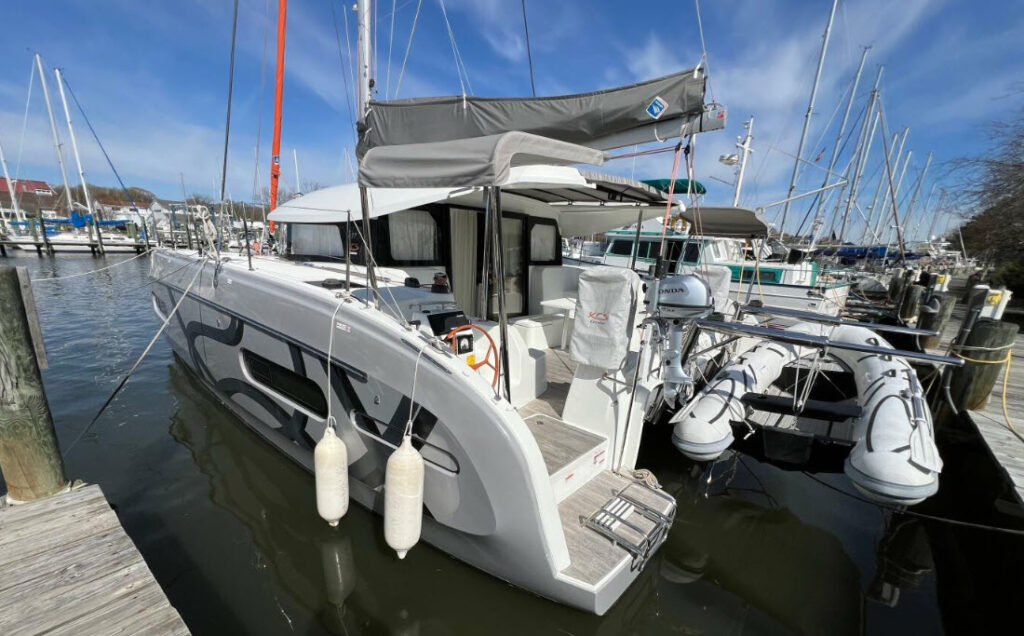
(Excess catamaran docked at the marina in Annapolis, Maryland.)
OUTSTANDING LIVABILITY
The stable, wide platform of a catamaran offers maximum living space, both in and around the cockpit and decks as well as inside the saloon and accommodations. With the lack of heeling associated with a multihull, life is grand when compared to some alternatives. Go ahead, leave the espresso machine and coffeemaker on the galley counter. There is also no need to move the flowerpot on the saloon table. You do not need gimbaled drink holders or high fiddles to keep things in place.
Under way, crew and guests are not confined to narrow cockpit seating but can spread out on lounge settees that are roomy and comfortable. There is no stepping over others to move around the boat. Guests can stay out of the sun under a fixed awning or overhead or sunbathe on the foredeck if they prefer. The open spaces are particularly great for kids on wide side decks and foredeck.
The visually open space has many benefits. The placement of the outdoor grill, for example, makes for summer cooking away from guests sitting in the cockpit, yet is safely within the lifelines and deck rather than requiring the cook to balance precariously on a crowded stern. Summer living, which can be hot and humid on the Bay during July and August, calls for cooking outdoors, letting the breeze and/or air conditioning keep comfortable temperatures inside the boat.
With trouble-free boarding from the swim platform or from the dinghy, a catamaran is excellent for cruising with kids and dogs. The wide side decks allow safe and unrestricted movement around the boat with less side stepping to avoid stays, cleats, and other hardware.
The foredeck is usually large enough for folding chairs for an unlimited view of the sunset or fireworks…or the Blue Angels.
Many find the catamaran has an ideal coastal cruising layout. With the owner’s stateroom and ensuite head dedicated in one hull, there is maximum privacy while keeping the interior open and inviting for all. Everyone has their space on the boat, even during extended cruises.
With staterooms placed in the hulls, the heads and showers on many cats offer luxury only seen on much larger yachts. Taking a shower in a large, dedicated space with full headroom and overhead hatch is a real treat. More than one couple has come over to the catamaran side of cruising because such creature comforts are not available in other boats in this size.
Standing headroom in the two hulls does bring up a consideration about boating in Chesapeake Bay. To accommodate headroom of 6’6” or more, the side decks of many cats are taller off the water than comparable monohulls, six feet or more above the waterline. Keep in mind that getting on and off a catamaran normally occurs around the swim platforms, which is ideal at floating docks and full-length piers. However, floating docks are not common around the Bay, especially in older marinas and facilities. Getting on and off if one cannot use the stern steps can be problematic. Climbing on or off a side deck that is four feet from the finger pier or dock can be challenging for even athletic crew, and much more so for older people, kids, and dogs.
In addition, many docks and slips have pilings that stand proud of the pier. Very few catamarans (or modern monohulls for that matter) have rubrails of any significance, so the hull sides are at risk of rubbing against these pilings. Regular fenders do not work at all with vertical pilings. Even round ball fenders are less than adequate. Fender boards or rectangular fender cushions are a better solution. The multiple tubes of rectangular-shaped fenders tend to stay in place better against a piling as the boat moves around in the slip.
Another comment is that a catamaran owner will occasionally find a challenge at the fuel dock, especially at older marinas. The fuel hose is sometimes not long enough to reach the far side, given the beam of catamarans. This may even require turning the boat around to get the other side deck closer to the fuel pump. Not a huge problem, but something to know, particularly with the larger fuel tanks of a power cat.
With these few exceptions, the catamaran’s design and layout provide outstanding comfort and livability. It is an ideal cruising choice for Bay cruising.
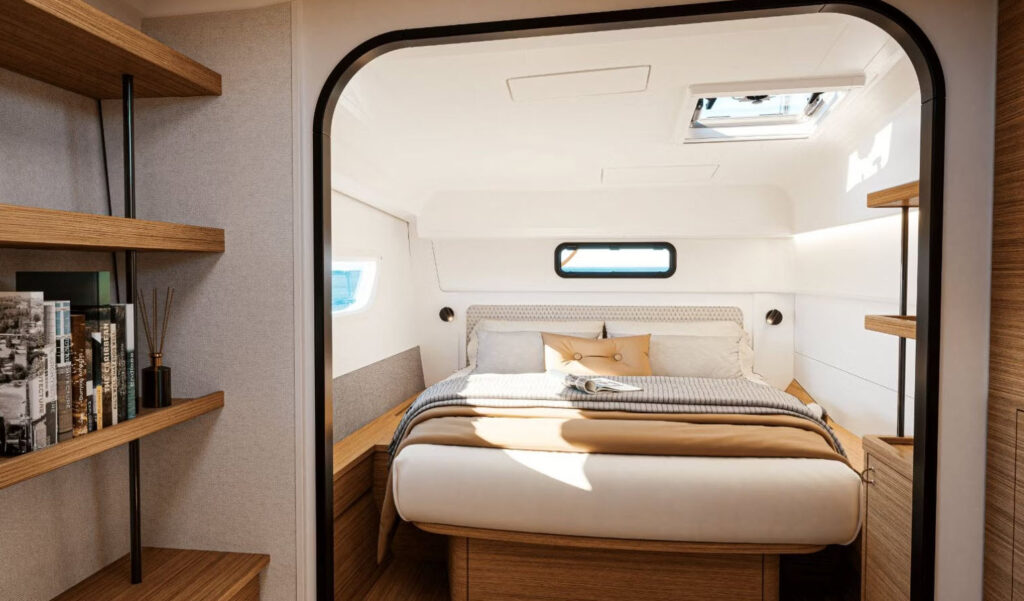
(Main cabin berth on the Excess 13 catamaran.)
ACCESSIBILITY
I am a huge fan of boats with excellent accessibility. I define this as being able to get to all major systems, controls, and components safely and easily on a boat. If you can get to it, you can inspect, service, and replace it when necessary. This is key to preventing problems.
Fittings and gear hidden out of sight, such as through-hulls, pumps, hoses, and electrical connections, still require inspection and attention at some point. If neglected, they will eventually fail, often at the worst possible time. Engines, filters, batteries, gensets, air conditioning units, water heaters, pumps, water systems, holding tank plumbing…all need to be accessible.
To me, this is the Holy Grail of Boat Ownership. Good access means proper inspection and maintenance…and prevention.
In my experience, the open nature of a catamaran means that the builder did not have to resort to squeezing wires, hoses, and connectors into hard-to-reach places. Engines can be positioned directly under hatches for superior access. Same with generators and major systems. Steering gear can be reachable from each lazarette, without unloading lockers, and the shallow bilges of each hull force the builder not to hide anything. I can work my way around most catamarans without suffering the aches and pains of cramped workspaces. After all, we call it pleasure boating. I find keeping a catamaran in tiptop shape to be very satisfying, and frankly, fun.
Enjoying morning coffee while seated in a comfortable chair watching the world come alive with the new day is one of the joys of cruising Chesapeake Bay. The morning serenity is special, whether tied up in Baltimore’s Inner Harbor, among the mast farms in Deltaville, or far up a creek on the Eastern Shore. Boating in all its many forms is justifiably popular on Chesapeake Bay. For folks cruising on catamarans, the experience can bring a new level of comfort and convenience to modern living.
A catamaran is an excellent choice for cruising Chesapeake Bay, with all the pleasures of life afloat on one’s own boat.
Crusader Yachts is your headquarters for boats for sale in Annapolis and the Chesapeake Bay area. We are new boat dealers for Excess Catamarans, Jeanneau Sailboats, and Tartan Yachts, as well as offer professional yacht brokerage services. Come see us at our office located at 7350 Edgewood Road in Annapolis or give us a call at (410) 269-0939 for more information about boating in the Chesapeake Bay area!
Other Articles Of Interest:
